Moroccan Kaftan vs Djellaba: What’s the Difference?
You have just landed in Marrakech. The air smells of spices, mint tea, and tanned leather. You step into the labyrinth of the Medina, surrounded by a kaleidoscope of colors. Everywhere you look, people are wearing flowing, elegant robes that seem to float as they walk.
You decide you want to buy one. You want to take a piece of this magic home with you.
You walk into a boutique, point to a gorgeous embroidered garment, and ask the shopkeeper for a “Kaftan.” He looks at you, smiles politely, and says, “Madam, that is a Djellaba.”
Confused? You aren’t alone.
To the untrained eye, Moroccan traditional clothing can look strikingly similar. Both are long, loose, and undeniably beautiful. But mixing them up is a bit like wearing a tuxedo to a grocery store, or wearing a hoodie to a royal wedding.
There is a world of difference between the two.
If you are a fashion enthusiast, a traveler planning a trip to North Africa, or just someone who appreciates the artistry of global textiles, you need to understand the Kaftan Djellaba difference.
But don’t worry.
By the end of this guide, you won’t just know the difference; you’ll be able to spot the nuances of stitching, fabric, and occasion like a local.
Let’s dive in.
The Fabric of Identity: Why This Matters
Before we dissect the seams and stitches, we need to understand the soul of these garments.
In Morocco, clothing is more than just fabric draped over the body. It is a language. It speaks of region, social status, tribal affiliation, and occasion.
Here is the deal:
While Western fashion often prioritizes trends that change every season, Moroccan fashion prioritizes heritage. The designs you see today are echoes of styles worn centuries ago in the courts of Sultans and the tents of Berbers.
When we explore the Kaftan vs Djellaba explained, we are actually exploring the duality of Moroccan life: the public vs. the private, the everyday vs. the ceremonial, the practical vs. the luxurious.
So, let’s meet our first contender.
What is a Kaftan? (The Queen of Elegance)
If Moroccan fashion were a hierarchy, the Kaftan (or Caftan) would be the Queen sitting on the throne.
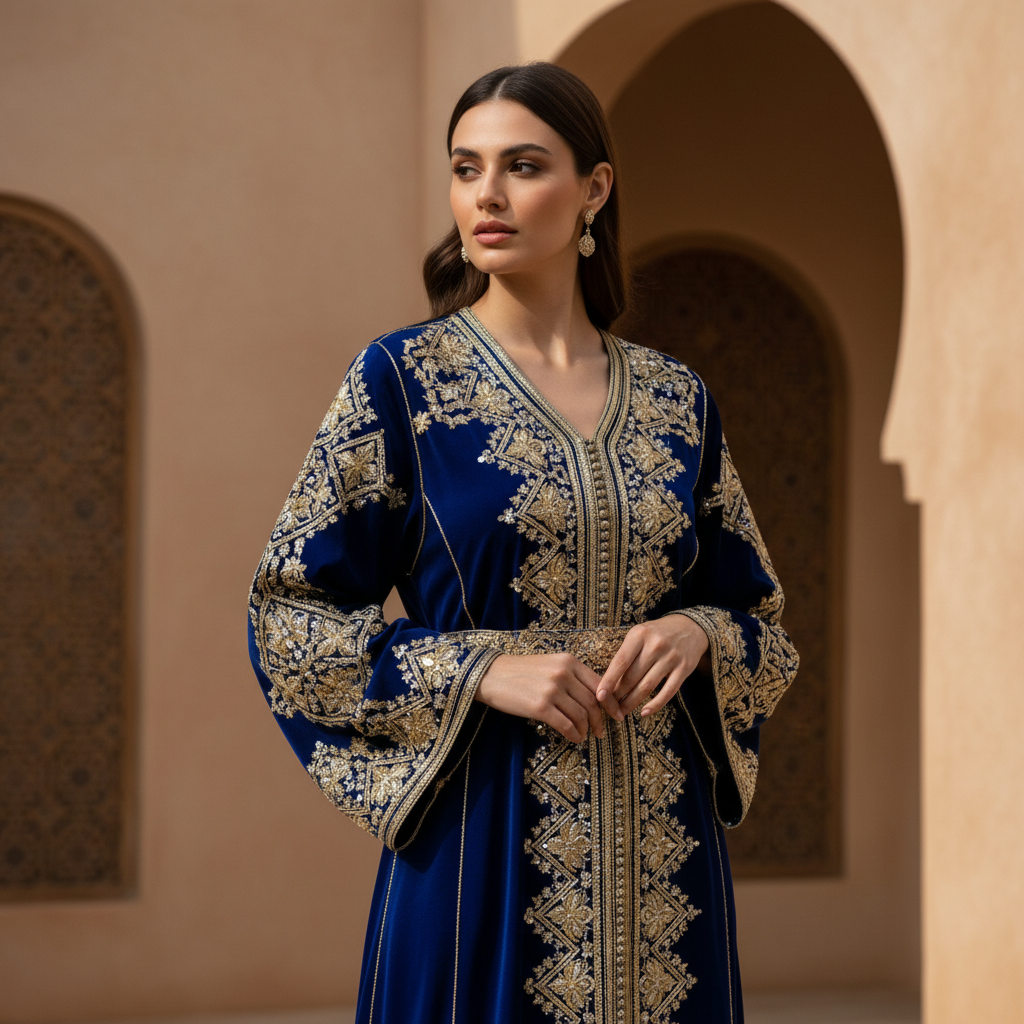
The Kaftan is synonymous with sophistication, femininity, and high celebrations. It is a garment that commands attention. When a woman walks into a room wearing a high-end Kaftan, heads turn.
A Brief History
The origins of the Kaftan stretch far beyond the borders of Morocco. Historians trace its roots back to ancient Mesopotamia and Persia. It traveled across the Middle East and was eventually adopted and adapted by the Moroccan dynasties (specifically the Marinids and Wattasids).
However, here is the interesting part:
While other cultures moved away from the Kaftan or modernized it beyond recognition, Morocco preserved it, refined it, and made it entirely its own. Today, the Moroccan Kaftan is distinct from its Turkish or Middle Eastern cousins.
Key Features of the Kaftan
How do you spot one? Look for these traits:
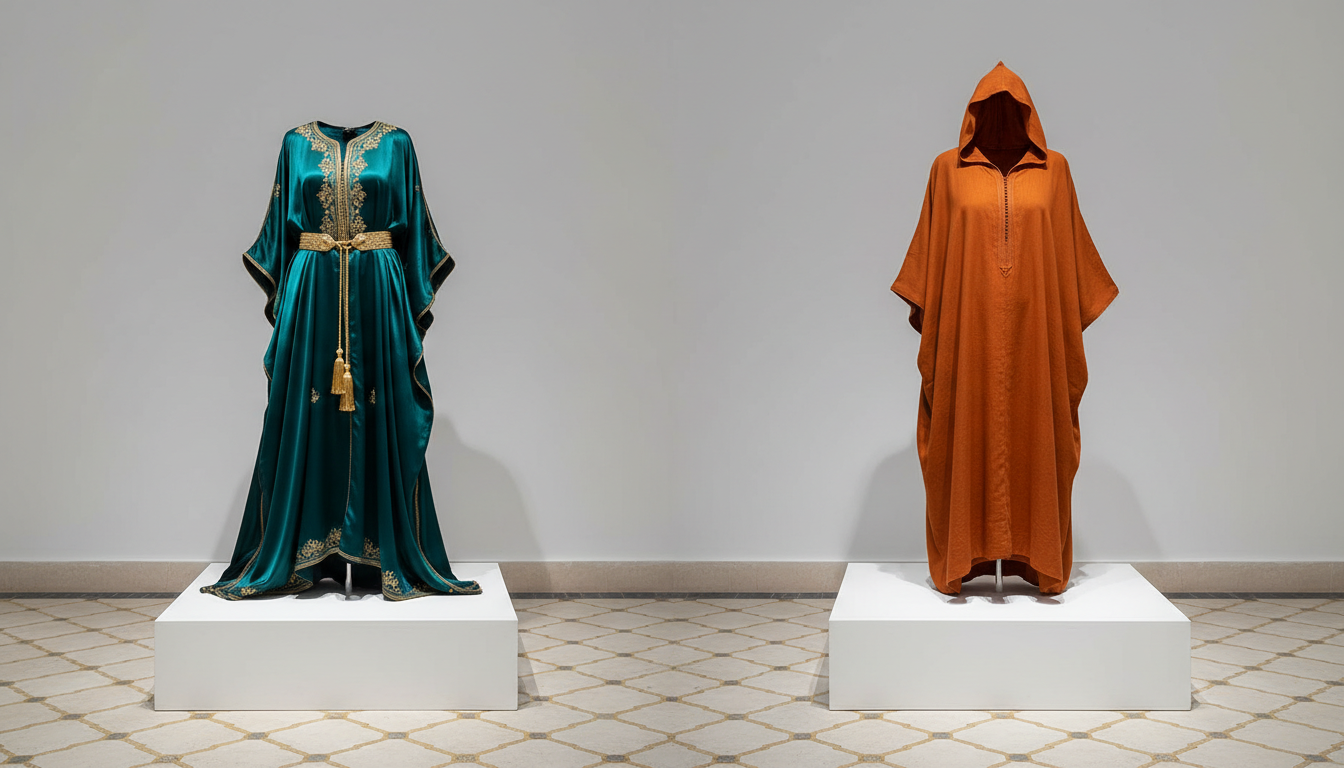
- No Hood: This is the number one rule. A traditional Moroccan Kaftan never has a hood.
- The Front Opening: Kaftans are traditionally open down the front, held together by a belt (Mdamma) or intricate buttonwork (Aakad).
- The Sleeves: Usually wider and often bell-shaped, though modern cuts vary.
- The Fabric: Think luxury. Velvet, silk, brocade, satin, and lace.
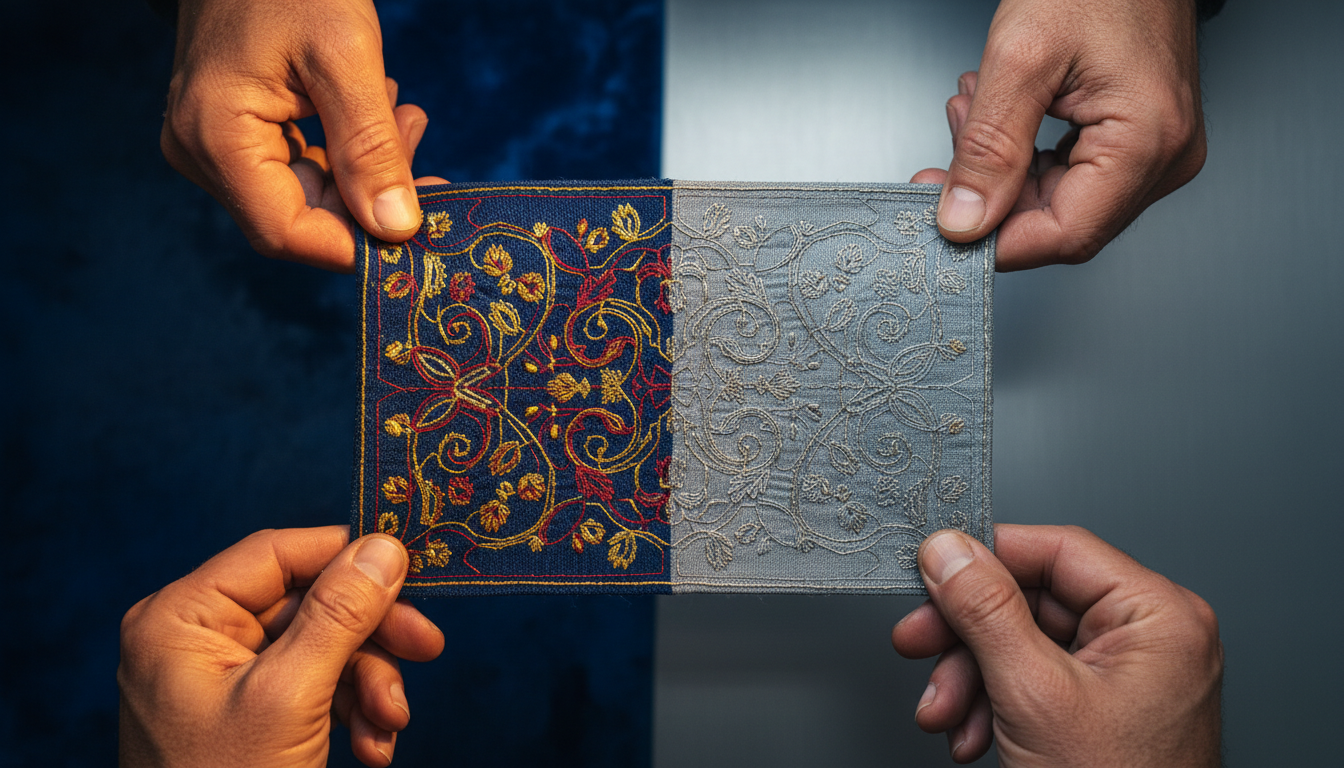
- The Embellishment: Kaftans feature heavy embroidery, beading, and the signature Sfifa (braided piping) running down the center.
The “Takchita” Twist
You might hear the word “Takchita” thrown around. Is it a Kaftan?
Yes and no.
A Takchita is a two-piece Kaftan. It consists of a base layer (a simple caftan) and a see-through or ornate outer layer, held together by a wide belt. If you are at a Moroccan wedding, 90% of the women are likely wearing Takchitas.
What is a Djellaba? (The Daily Essential)
Now, let’s shift gears.
If the Kaftan is the ballgown, the Djellaba is the trench coat, the hoodie, and the business suit all rolled into one.
The Djellaba is the heartbeat of the Moroccan street. It is ubiquitous. Men wear them. Women wear them. Children wear them. It is the ultimate garment of modesty and practicality.
A Brief History
The Djellaba has Berber (Amazigh) roots. It was born out of necessity in the Atlas Mountains. The original purpose was protection—protection from the biting cold winds of the mountains and the scorching sun of the desert.
The Identifying Feature: The “Qob”
Here is the secret to instantly identifying a Djellaba.
Look for the hood.
In Morocco, this hood is called the Qob. Historically, it served a brilliant dual purpose.
- Weather Protection: Pulled up to shield against sandstorms or rain.
- Storage: When the hood hangs down the back, it often acts as a pocket for carrying bread or small groceries!
Key Features of the Djellaba
- The Hood (Qob): Always present. Large and pointy.
- The Cut: Generally looser and wider to fit over regular clothing.
- The Sleeves: Long, but usually not as wide or flowing as a Kaftan.
- The Neckline: Usually has a small slit or zipper to allow the head to pass through, but it doesn’t always open all the way down like a Kaftan.
- Gender Neutrality: Both men and women wear Djellabas, though the cuts and colors differ significantly. Men’s are usually plain (white, grey, brown, striped), while women’s come in every color and pattern imaginable.
Kaftan vs Djellaba: The Comparison
Now that we have defined the players, let’s put them head-to-head.
This is where many travelers make mistakes. They buy a fancy Djellaba thinking it’s formal wear, or a simple Kaftan thinking it’s street wear.
Here is the breakdown of the Kaftan Djellaba difference across critical categories.
1. The Anatomy of the Garment
| Feature | Kaftan | Djellaba |
|---|---|---|
| Hood | Never. (This is the golden rule). | Always. (The pointy hood/Qob). |
| Opening | Usually open down the front (buttoned). | usually closed, pull-over style. |
| Sleeves | Wide, flared, ornate. | Straight, functional. |
| Accessories | Almost always worn with a Belt (Mdamma). | Never worn with a belt (loose flow). |
| Layers | Can be one or two pieces (Takchita). | Always a single piece. |
2. The Formality Scale
Think of it this way:
- The Djellaba is your “Outerwear.” It is what you wear over your house clothes or pajamas to run errands, go to work, or visit the mosque. It is modest and covers the body completely.
- The Kaftan is your “Event Wear.” It is worn indoors at parties, weddings, religious holidays (like Eid), or engagement ceremonies.
Pro-Tip: You would rarely see a woman walking down a busy street in a heavy velvet Kaftan unless she is literally stepping out of a car to enter a wedding hall. Conversely, wearing a wool Djellaba to your sister’s wedding reception would be considered underdressed.
3. Fabric and Weight
Because their purposes are different, their materials are different.
- Djellaba Materials: diverse. In winter, you will find heavy wool and fleece to combat the cold. In summer, you will find light cotton, linen, or synthetic blends for breathability.
- Kaftan Materials: Opulent. Silk, velvet, brocade, crepe, organza. They are often heavy due to the amount of beading and embroidery.
Similarities: The Shared DNA
Despite their differences, it is important to acknowledge why people get them confused. They share a common DNA of Moroccan traditional clothing.
- The Maallam’s Touch: Both garments utilize traditional finishing techniques. Both use Sfifa (braided trimmings) and Aakad (hand-knotted buttons).
- Modesty: Both are designed to be respectful and modest, covering the majority of the body.
- Artistry: Whether it is a simple everyday Djellaba or a royal Kaftan, both are often handmade by artisans, not mass-produced in factories.
But wait, there is more.
Modern fashion designers are blurring the lines. You can now find “indoor Djellabas” made of satin for hosting dinners, and “casual Kaftans” made of linen for beach wear. However, the rule of the Hood generally remains the best indicator.
When to Wear Which: A Traveler’s Guide
Are you planning a trip? Or perhaps you have been invited to a Moroccan themed dinner? Here is a cheat sheet on what to wear so you look like a pro.
Scenario A: Exploring the Medina
You are walking around Fez or Marrakech, shopping, taking photos, and visiting museums.
- Wear: A Djellaba.
- Why: It is comfortable, culturally respectful, and protects you from the sun. Plus, you will get fewer stares than if you are wearing Western tight clothing.
Scenario B: Attending a Moroccan Wedding
You have been invited to the actual party (which usually starts late at night).
- Wear: A Kaftan or Takchita.
- Why: This is the time to shine. The shinier, the better. If you show up in a Djellaba, you will look like you stopped by on your way to the grocery store.
Scenario C: Dinner at a Local’s House
You are invited for Couscous on a Friday.
- Wear: A nice Djellaba or a simple, cotton Kaftan (often called a Gandoura if it has short sleeves and no hood).
- Why: You want to look nice but comfortable. A heavy wedding Takchita would be too much, but pyjamas are too little.
How to Spot Quality (Don’t Get Ripped Off)
If you are looking to buy Moroccan traditional clothing, you need to know how to spot quality. The market is flooded with cheap, machine-made imports.
Here is how to tell the difference between a tourist trap garment and a real piece of art.
1. Check the Embroidery (Sfifa)
Look closely at the braiding down the front.
- Machine made: perfectly uniform, flat, and feels synthetic.
- Handmade (Maallam): slightly raised, intricate, and has a weight to it.
2. Check the Buttons (Aakad)
- Cheap: Plastic buttons or loose thread knots.
- Quality: Firm, tight knots that feel like little stones.
3. The Fabric Test
Rub the fabric between your fingers. Natural fibers (cotton, wool, silk) breathe. Synthetic polyester (common in cheap tourist shops) will make you sweat and has a shiny, plastic sheen.
The Modern Evolution
It is fascinating to see how these garments are evolving.
In recent years, the Moroccan Kaftan has hit global runways. Designers like Yves Saint Laurent were famously obsessed with Moroccan fashion. Today, you see Kaftan-inspired silhouettes in collections from Gucci to Oscar de la Renta.
The Djellaba is also getting a makeover. Young Moroccan designers are creating “short Djellabas” (stopping at the knee) to be worn with jeans, merging streetwear with heritage.
This evolution proves that Moroccan traditional clothing isn’t a relic of the past; it is a living, breathing fashion ecosystem.
Conclusion: More Than Just Threads
So, Moroccan Kaftan vs Djellaba: What’s the difference?
It comes down to this:
The Djellaba is the shield. It is the hood that protects, the wool that warms, and the modesty that allows one to navigate the public world with grace. It is the uniform of the people.
The Kaftan is the jewel. It is the celebration of beauty, the display of craftsmanship, and the mark of joy. It is the garment of the soul.
Both are essential. Both are beautiful. And both tell the story of a culture that values artistry and elegance in every stitch.
Ready to Find Your Style?
Next time you find yourself wandering the winding alleyways of a Moroccan Souk, don’t just look at the colors. Look for the hood. Look for the split. Feel the fabric.
Now that you know the secret language of Moroccan fashion, you aren’t just a tourist buying a souvenir. You are a connoisseur collecting a piece of history.
Have you ever worn a Kaftan or a Djellaba? Which style resonates more with your personality? Let us know in the comments below!
Tags